


Your front desk is still on hold with a payer, trying to confirm whether a patient’s MRI needs prior authorization. Two referrals from last week never got scheduled. And the claim that came back denied on Monday? Nobody has had time to look at it.
If that sounds familiar, you’re not running a bad practice. You’re running a normal one. Independent practices carry much of the same administrative load as large health systems, just with a fraction of the staff. That gap is exactly what healthcare back-office outsourcing is meant to close.
But outsourcing isn’t all-or-nothing. Some tasks belong with a specialist partner. Others should stay under your roof. This guide breaks down which is which, so you can make the call with a clear head instead of a full inbox.
What Is Healthcare Back-Office Outsourcing?
Healthcare back-office outsourcing means handing the administrative work that happens behind the scenes to an outside team. Patients rarely see this work, but your revenue depends on it.
Think of your practice in two halves. The front office is everything the patient touches: check-in, scheduling, the phone call to reschedule. The back office is what keeps the lights on after they leave. That includes verifying insurance, securing prior authorizations, coordinating referrals, working denials, following up on unpaid claims, and keeping documentation compliant.
A medical back-office support company takes on some or all of that work. Good partners plug into your existing EHR and practice management system, follow your workflows, and report back to you. You still run the practice. They carry the paperwork.
Signs Your Practice Is Ready to Outsource Back-Office Work
Most practices don’t decide to outsource on a calm day. They get pushed there. Here are the signals worth paying attention to:
- Denials keep tracing back to the front end. Change Healthcare’s 2024 Denials Index found that about 44% of claim denials start with front-end problems such as eligibility and registration errors. If your denial reports keep saying “coverage terminated” or “authorization required,” the problem sits upstream of billing.
- Prior auths are piling up. In the AMA’s 2026 physician survey, practices reported completing around 40 prior authorizations per physician each week, taking roughly 13 hours of physician and staff time.
- Your staff is stretched thin and turnover is rising. Every time a trained biller or authorization coordinator leaves, months of payer knowledge walk out the door with them.
- A/R is aging. When the pile of claims over 90 days keeps growing, it usually means nobody has time to chase them.
- Physicians are doing admin work. If your doctors are calling payers during lunch, that time costs more than it looks.
One of these on its own might just be a staffing hiccup. Two or three together usually means the system needs to change, not the people.
6 Back-Office Tasks Medical Practices Should Outsource
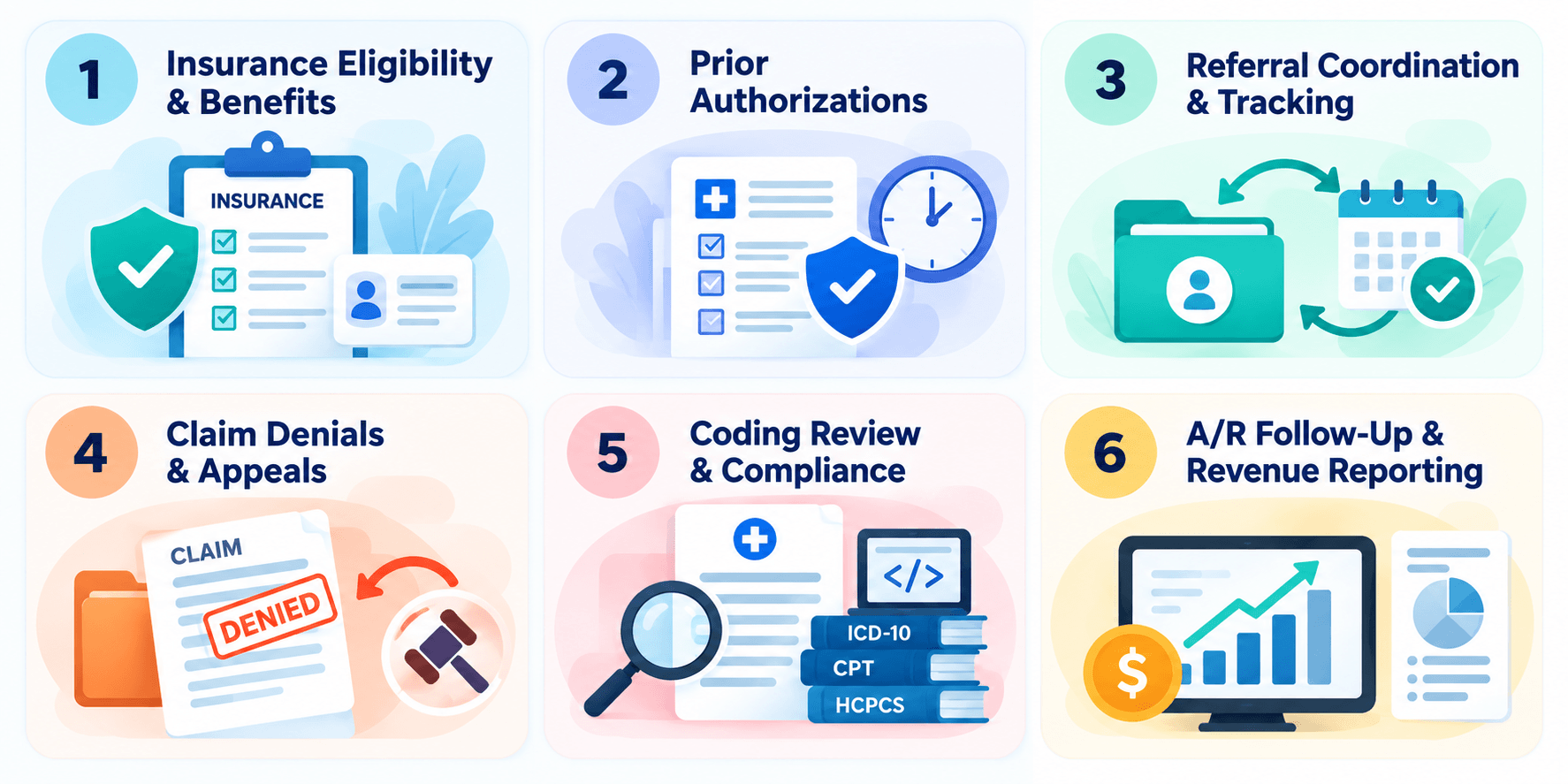
These are the functions where outsourcing tends to pay off fastest. They’re repetitive and rules-heavy, and they reward people who do them all day, every day.
1. Insurance Eligibility and Benefit Verification
Verification sounds simple until you’re doing 60 of them a day. Coverage changes, patients switch plans in January, and secondary insurance gets missed. A dedicated team checks active coverage, copays, deductibles, out-of-pocket limits and authorization requirements before the visit, not after the denial.
Outsourced insurance benefit verification services work best when checks happen 48 to 72 hours before the appointment. That gives your office time to call the patient about a lapsed policy or an unexpected cost, which also makes front-desk collections a lot smoother.
2. Prior Authorizations
Prior authorization is one of the biggest time drains in any specialty practice. Each payer has its own rules, portals, forms and clinical criteria, and those rules change often.
There is some relief. Under the CMS Interoperability and Prior Authorization Final Rule (CMS-0057-F), affected payers, including Medicare Advantage, Medicaid and ACA marketplace plans, now have to respond within 72 hours for urgent requests and seven calendar days for standard ones. Faster payer responses only help, though, if your submission is complete the first time. A specialized team knows what documentation each payer expects, tracks every pending request, and follows up before an appointment is at risk. For the most common mistakes, see our guide on how to reduce prior authorization denials.
3. Referral Coordination and Tracking
Referrals are where patients quietly slip away. A referral gets faxed, sits in a queue, and the patient never gets scheduled or ends up at another practice. That’s lost revenue and, more importantly, a gap in care.
Referral coordination services close that loop. The outsourced team confirms the referral arrived, checks whether authorization is needed, gets the patient on the schedule, and sends notes back to the referring provider. Referring physicians notice when their patients are looked after, so closed-loop tracking strengthens those relationships too.
4. Claim Denials and Appeals Management
Every denied claim is money you’ve already earned but haven’t collected. Yet many practices only work the easy denials and let the complicated ones quietly age out.
An experienced appeals team sorts denials by root cause, corrects and resubmits what can be fixed, and writes formal appeals with the right clinical documentation when a payer gets it wrong. Just as useful, they report patterns back to you. If one payer keeps denying the same CPT code, you want to know, so you can fix it at the source instead of appealing it forever.
5. Coding Review and Documentation Compliance
Coding errors hurt practices in two directions. Undercoding leaves money on the table. Overcoding creates audit risk. Certified coders reviewing charts against ICD-10, CPT and HCPCS guidelines catch both before the claim goes out.
Outsourced compliance support also covers HIPAA practices, payer-specific documentation rules and periodic internal audits. For a small practice without a dedicated compliance officer, that’s a real safety net. We explain more in how medical coding errors are quietly costing your practice thousands.
6. A/R Follow-Up and Revenue Reporting
An unpaid claim won’t chase itself. Someone on the team has to check status, call payers about stalled claims, and push back on underpayments. An outsourced A/R team works aged claims in a set order and gives you regular reports on days in A/R, collection rates and denial trends.
That reporting is often the most underrated part. When you can see your numbers every month, you make better decisions about staffing, payer contracts and growth.
What to Keep In-House
This is where many outsourcing guides go quiet. Not everything should leave your building, and a good partner will tell you so.
Patient relationships. Greeting patients, handling sensitive conversations about bills, and the personal touch that keeps people loyal to an independent practice belong with your own team.
Clinical decisions. Your outsourced team can gather records and prepare a prior auth packet. Your providers decide what care is needed and handle peer-to-peer reviews when medical judgment is being questioned.
Final say on financial policy. Write-offs, payment plans, charity care and fee schedules are your decisions. Your partner can recommend. You approve.
An internal point person. Even if you outsource most back-office work, one person on your staff should own the relationship, review reports and raise issues early. Outsourcing works best as a partnership, not a hand-off.
In-House vs Outsourced Back Office: A Quick Comparison
Factor | In-House Team | Outsourced Partner |
Cost | Salaries, benefits, training, software and turnover | Predictable fee, usually lower than hiring for the same coverage |
Staffing | Gaps when someone is sick, on leave or quits | Team-based coverage with backup built in |
Expertise | Depends on one or two people’s experience | Specialists who work payer rules every day |
Scalability | Hiring and training take months | Scales when you add providers or locations |
Compliance | Fully on you to train and audit | Shared, with HIPAA-trained staff and regular audits |
Visibility | Direct oversight, but reporting is often informal | Structured reports, if you pick the right partner |
In-house works well for some practices, especially larger groups with stable, experienced staff. For most small and mid-sized independent practices, though, a hybrid model tends to win: outsource the rules-heavy tasks and keep the patient-facing work in-house. You get the cost savings and expertise without giving up control.
What a Hybrid Back Office Looks Like Day to Day
Numbers and checklists are useful, but it helps to picture the actual workflow. Here’s a typical example for a four-provider specialty clinic that moves to a hybrid model.
On Monday, the outsourced team pulls the schedule for Wednesday and Thursday and runs eligibility checks on every patient. Two patients show inactive coverage, so the clinic’s front desk gets a flag that morning and calls them before the visit, not after.
At the same time, three procedures on next week’s schedule need prior authorization. The team submits them with the right notes attached, tracks the status in a shared sheet, and escalates one that’s stalled. A physician only gets involved when a payer requests a peer-to-peer review.
Meanwhile, new referrals are logged as they arrive, checked for authorization needs, and scheduled. By Friday, the practice manager gets a short report: verifications completed, auths approved and pending, denials worked, and A/R movement for the week.
Nothing about the patient experience changes, except that fewer things go wrong. That’s the real goal of healthcare back-office outsourcing: fewer surprises, steadier cash flow, and a team that can finally leave on time.
How to Choose a Medical Back-Office Support Company
Not every partner is a good fit. Before you sign anything, ask about these six things:
- HIPAA compliance and data security. Ask for a signed Business Associate Agreement (BAA) and details on how staff access and protect patient data.
- Specialty experience. A team that already knows cardiology prior auths or rheumatology infusion benefits will outperform a generalist.
- Fit with your EHR and PM system. They should work inside the software you already use, not push you onto a new platform.
- Transparent reporting. You should get regular numbers on turnaround times, denial rates and A/R, not just an invoice.
- A dedicated contact. One account manager who knows your practice makes a big difference when something urgent comes up.
- Flexible terms. Be wary of long lock-in contracts. A confident partner lets results do the talking.
It’s also worth asking for references from practices your size. A company built around 500-bed hospitals may not understand how a three-provider clinic runs.
How MedAxis Solutions Supports Independent Practices
At MedAxis Solutions, we built our back-office management services for independent physicians and specialty practices. Our team handles referral management, medical benefit verification, prior authorizations and appeals, supported by certified coders and a full medical billing and coding team.
We work inside your existing systems, follow your workflows, and give you clear reporting so you always know where things stand. If you’re weighing a bigger change, our article on what a medical MSO is and why practices need one is a good next read.
Want to see how much time your team could get back? Book a free consultation with MedAxis Solutions and we’ll walk through your current back-office workflow together.