

Ever-rising healthcare costs and shrinking profit margins present a major financial challenge for medical practices struggling to balance clinical passion with business realities.
On the one hand, commercial reimbursement rates are declining, and when combined with stricter compliance rules and a highly competitive healthcare labor market, Independent practices and medical groups find themselves in an operational dilemma.
Most practices resort to cost-cutting measures such as postponing hiring, delaying software updates, or, most commonly, pushing the billing workflows onto front-desk staff.
Far from resolving the crisis, these temporary fixes end up creating billing backlogs, compliance risks, and the much-talked-about clinical burnout.
The True Anatomy of Medical Practice Overhead
When it comes to medical practices, it’s complicated to view the administrative overhead strictly in terms of profits and losses. It’s not merely a question of paying base salaries but includes an array of operational expenses that come with establishing an in-house administrative infrastructure. These expenses can quietly build up over time until you notice their effects on your cash flow.
Total Administrative Overhead | ||
|---|---|---|
Direct Costs | Latent Overhead | Infrastructure |
Base Salaries | Health Insurance | EHR User Licenses |
Shift Premiums | PTO & Sick Leave | Physical Desks |
Overtime Pays | CE & Training | Square Footage |
A fundamental change in the traditional operational model is required to sustain margins and set up a thriving practice. Healthcare business process outsourcing (BPO) has emerged as a viable alternative that allows businesses to shift from a rigid, expensive overhead structure towards an agile and flexible model that drives higher performance.
The “Cost-per-Desk” Real Estate Factor
When you hire an in-house medical biller, credentialing specialist, or human resources manager, you have to pay an additional cost beyond that of their services rendered. Each of these functions requires a physical space, which means less space is available for patient care.
When administrative workflows are transferred to a remote partner, practices can leverage existing back-office areas for medical purposes like exam rooms or specialized testing that increases their revenue potential.
The Technology Stack Squeeze
The modern healthcare tech stack has become a significant capital drain. Operating a competitive practice requires access to sophisticated software tools like EHR extensions, enterprise-grade schedulers, and advanced claim-scrubbing platforms. For independent practices, managing individual user licenses, constant software updates, and the underlying IT infrastructure creates a compounding cycle of technology debt.
Latent Staffing Expenses
When calculating the total cost of an internal employee, you cannot do so with merely their hourly rate. It is equally crucial to factor in the secondary costs, including their insurance obligations, paid time off (PTO), workers’ compensation, and 401(k) matching.
Beyond the financial costs, you need to consider the administrative hours put into payroll management. Altogether, it is clear that the total costs incurred by an employee add up to 1.25 to 1.4 times their base salary. Transitioning these workflows to a specialized partner mitigates these hidden compounding liabilities.
The Hidden Dividends: Beyond Line-Item Savings
Lowering immediate operational expenses is highly beneficial, but it is just one aspect of outsourcing. A true practice management partnership will yield long-term benefits for your bottom line by curtailing risks in payment processes and maximizing reimbursements your revenue collection.
Compliance and Claim Denial Mitigation
Keeping up with ever-changing Medical billing rules can be challenging, where a single clerical oversight can trigger an immediate insurance denial. Common mistakes include referring to an outdated ICD-10 code or missing the deadline for prior authorization, which can put their hard-earned revenue at stake.
Delegating to practice management specialists helps mitigate the risk of denials as they use credentialed coding and proactively scrub claims to catch errors before they are submitted.
This dedicated approach to medical billing and collections directly reduces your Days in Accounts Receivable (DAR), stabilizes your cash flow, and protects your practice from costly compliance audits.
In-House vs Outsourced Billing | ||
|---|---|---|
Metric | In-house staff | Managed Partner |
Industry Average Clean Claim | 75%-80% | 95% + |
Days In Accounts Rec. (DAR) | 45-60 + Days | < 30 Days |
Compliance Oversight | Fragmented | Dedicated BAA |
Reclaiming Clinical Productivity
Physicians are hard-pressed to attend to various non-clinical tasks like preparing credentialing paperwork, reviewing administrative scheduling bottlenecks, or managing internal workplace disputes that consume a significant portion of their time.
By offloading back-office operational burdens, physicians can reclaim valuable time to focus on their primary responsibility. This frees them up to spend more time on patients, expand their care options, and regain a work-life balance that prevents professional burnout.
How Strategic Outsourcing Minimizes Practice Expenses
Outsourcing practice management to a specialized Management Services Organization (MSO) structuralizes your expenses, directly reducing line-item liabilities.
Converting Fixed Infrastructure into Variable Capital
An in-house administrative payroll is a fixed liability. This means that overhead costs stay constant whether your patient volume drops during seasonal holidays or surges during flu season.
Working with a practice management provider aligns your operational costs directly with your actual patient and revenue volume. This protects against fluctuating patient volumes so that you can adjust your administrative expenses accordingly. Having a cash reserve helps keep your practice up and running when you receive fewer patients than you normally do.
Breaking the Recruitment and Turnover Cycle
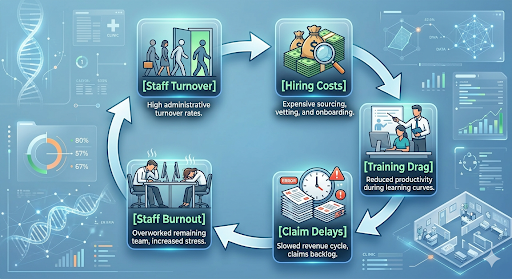
Industry data reveals that the healthcare sector is battling with a historically high average turnover of 20.7% among healthcare staff. This forces healthcare to go through endless recruitment cycles that require practices to invest considerable time and money in finding, vetting, onboarding, and training a qualified medical coder or insurance verification specialist.
When an internal staff member resigns, your remaining team must pick up the slack, which frequently causes a backlog in claims processing and billing errors. A practice management partner assumes all responsibility for staffing, training, and operational redundancies, ensuring your workflows proceed uninterrupted by internal sick days or staff departures.
Mitigating Technology Debt
A specialized outsourcing partner provides access to a variety of healthcare IT tools like billing, scheduling, and other operational technology without having to purchase individual software licenses.
Apart from being cost-effective, an enterprise partner further maintains complex server infrastructure and implements platform integrations and tech updates to meet evolving hardware and compliance requirements. This relieves modern practices from a loop of unpredictable capital investments while digitizing their operations.
Operational Triage: What to Outsource First
You do not need to restructure your entire clinical footprint overnight. A phased approach to transitioning workflows can keep expenses in control without disrupting the smooth flow of your day-to-day operations.
Phase 1: Revenue Cycle Management (RCM)
This phase is directly linked to your cash flow and comprises a host of financial functions, medical billing, coding, and denial management. By outsourcing your collections and payments to a financial expert, the percentage of claims that are processed successfully on the first submission surges as billing accuracy improves. These experts look into errors and verify information to minimize the chances of errors or documentation conflicts that trigger claim denials.
Phase 2: Insurance Verification and Prior Authorizations
Both insurance verification and prior authorizations are high-volume and time-consuming administrative tasks that rely on back- and forth negotiations with payers. This can detract the front desk from attending to the patients queuing for services. Outsourcing these services ensures that patients seeking treatment are assessed against predetermined eligibility criteria before they access care.
Phase 3: Centralized Scheduling and Patient Intake
The physical office is frequently overwhelmed with a continuous flow of patient inquiries and complex appointment bookings. The excessive workload can force them to work extended shift hours or absorb costly local overtime premiums that can drain their energy and result in a loss of time. By centralizing these front-office tasks with an external team, you eliminate staff burnout and reclaim valuable time that should be directed toward in-person patient care.
Elevate Your Practice Margins with MedAxis Solutions
Lowering your administrative overhead is not about cutting corners; it is about building a scalable, resilient operational foundation. An expert partner provides you with the necessary infrastructure to manage administrative responsibilities without being affected by a volatile labor market.
Beyond financial savings, it is a viable solution to get rid of spiralling overhead costs and optimize your revenue cycle to unlock your real business potential.
At MedAxis Solutions, we specialize in customized, fully integrated practice management systems designed exclusively for healthcare providers and medical groups. We handle the complexities of the back office so you can focus entirely on delivering exceptional patient care.
Is your practice administrative overhead eating into your care margins?
Contact the MedAxis Solutions team today to request a comprehensive practice workflow and assess ways to optimize your overhead costs.